
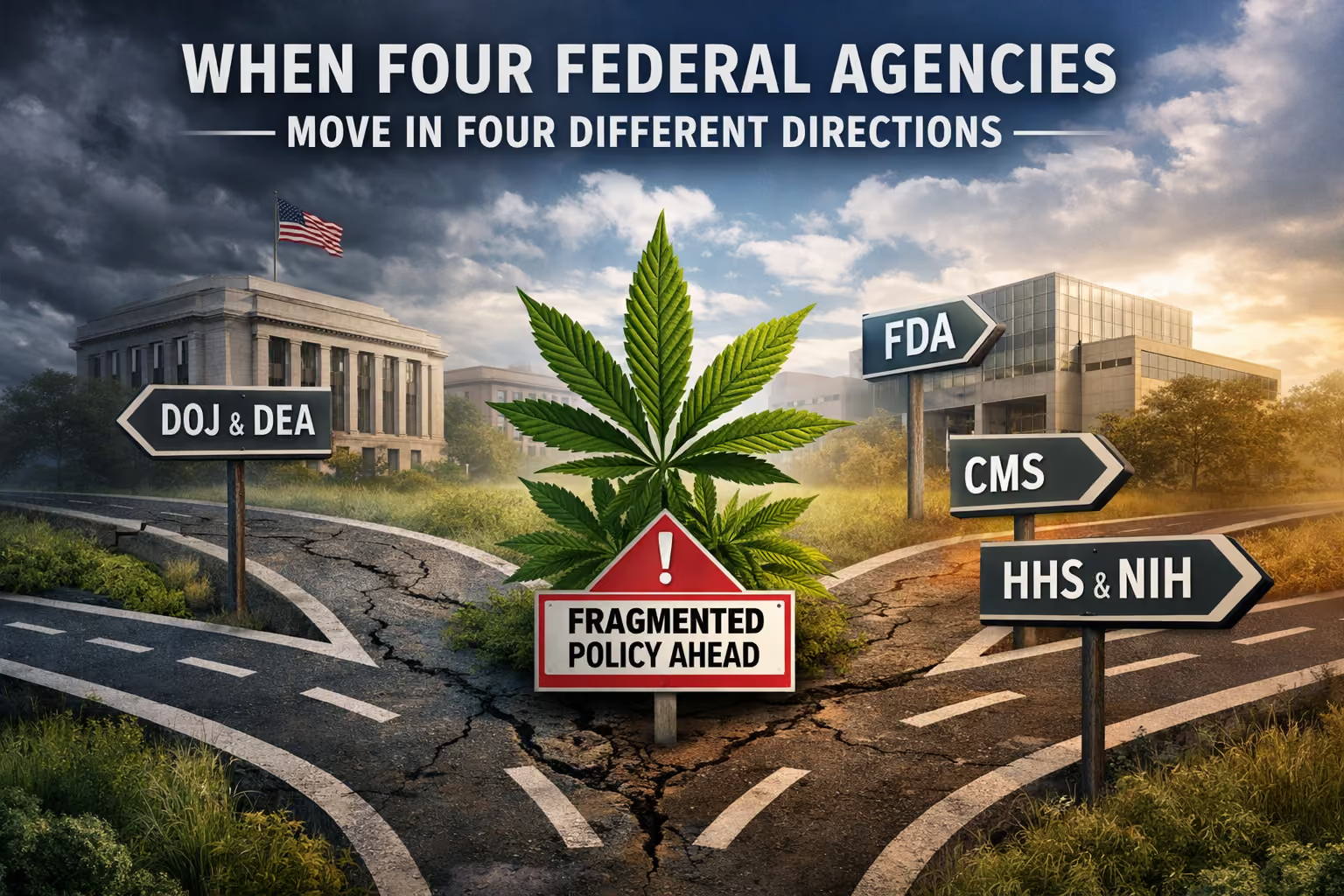
The federal government is more engaged in cannabis than it has ever been. This much is clear.
Just this week, White House officials signaled another step forward, reviewing a proposed FDA rule on CBD compliance and enforcement. It’s the kind of headline that suggests progress. Another meeting. Another review. Another signal that something is moving. And maybe it is.
But zoom out, and a different picture starts to emerge.
A System Moving Without Alignment
Each of these efforts is meaningful on its own.
- Rescheduling could reshape tax treatment and research access.
- FDA oversight could bring much-needed standards to CBD products.
- CMS involvement signals a shift toward medical legitimacy.
- Expanded research led by HHS and NIH could finally close long-standing data gaps.
But here's the critical issue... these initiatives are not moving together.
Different timelines. Different priorities. Different definitions of risk. And for cannabis businesses, that creates a new kind of complexity. Not just regulatory burden, but regulatory fragmentation.
We appear to have evolved from lack of activity, to lack of coordination.
The Risk Isn’t Regulation. It’s Misalignment.
Cannabis operators have shown they can adapt to regulation. In many cases, they’ve built highly disciplined businesses under some of the most complex compliance frameworks in any industry. What’s harder to navigate is inconsistency.
One agency signals expansion. Another signals restriction. A third delays guidance altogether.
The same headline that suggests forward movement also tells a more complicated story. The FDA is advancing a proposal focused on compliance and enforcement, even as it has missed prior deadlines and still has not established a clear commercial pathway for CBD products .
At the same time:
- Rescheduling remains in process, with no clear timeline for completion
- New federal limits on hemp-derived products are being introduced
- Healthcare policy is beginning to incorporate cannabinoid products in limited ways
- Research efforts are being expanded across agencies
Individually, each of these developments could be positive or at least constructive. But together, they create a landscape that is harder to interpret, harder to plan around, and harder to operate within unless they're aligned.
Businesses Are Forced to Bridge the Gaps
When systems don’t connect, operators have to do it themselves. That shows up in real ways:
- Building internal processes to reconcile conflicting guidance
- Managing compliance across overlapping and sometimes contradictory rules
- Making financial decisions without clear forward visibility
- Absorbing higher costs tied to uncertainty and inefficiency
Bridging these gaps requires more than awareness of policy changes. It requires systems, processes, and partners that can translate uncertainty into something actionable.
That means structuring banking, payments, reporting, and compliance in a way that holds up across shifting regulatory expectations, not just today’s rules.
The Next Phase of Cannabis Will Be Defined by Infrastructure
For years, the conversation has centered on legalization, decriminalization, and rescheduling. The industry is now operating at a level where coordination, standardization, and execution matter just as much as policy direction.
Financial infrastructure. Compliance systems. Operational support.
These are the layers that allow businesses to function when the broader environment is unclear. They are also the layers that enable growth when the environment eventually stabilizes.
This is the role Safe Harbor has focused on from the beginning. Not reacting to policy headlines, but building the financial infrastructure that allows cannabis businesses to operate through them.
Moving Forward Without Waiting
There is a tendency to wait for clarity. To assume that once rescheduling is complete, or once federal rules are finalized, the path forward will become easier. But progress in cannabis rarely arrives as a single, coordinated shift. It comes in pieces. A headline here. A proposal there. A delayed rulemaking process somewhere else.
Businesses that succeed in this environment will not be the ones waiting for alignment. They will be the ones built to operate without it.
A More Realistic View of Progress
Federal engagement in cannabis is real. It is increasing. And it will continue to evolve. The latest signals out of Washington reinforce that reality. Movement is happening. But it is happening in fragments, across agencies that are not yet operating within a unified framework. Until that changes, the burden of connecting those dots will remain on the industry itself.
Safe Harbor’s role is to help businesses navigate that reality with structure, clarity, and systems that work across uncertainty... not just within it.
And that is the reality cannabis operators are navigating today.
Not a lack of progress.
But progress without coordination.