
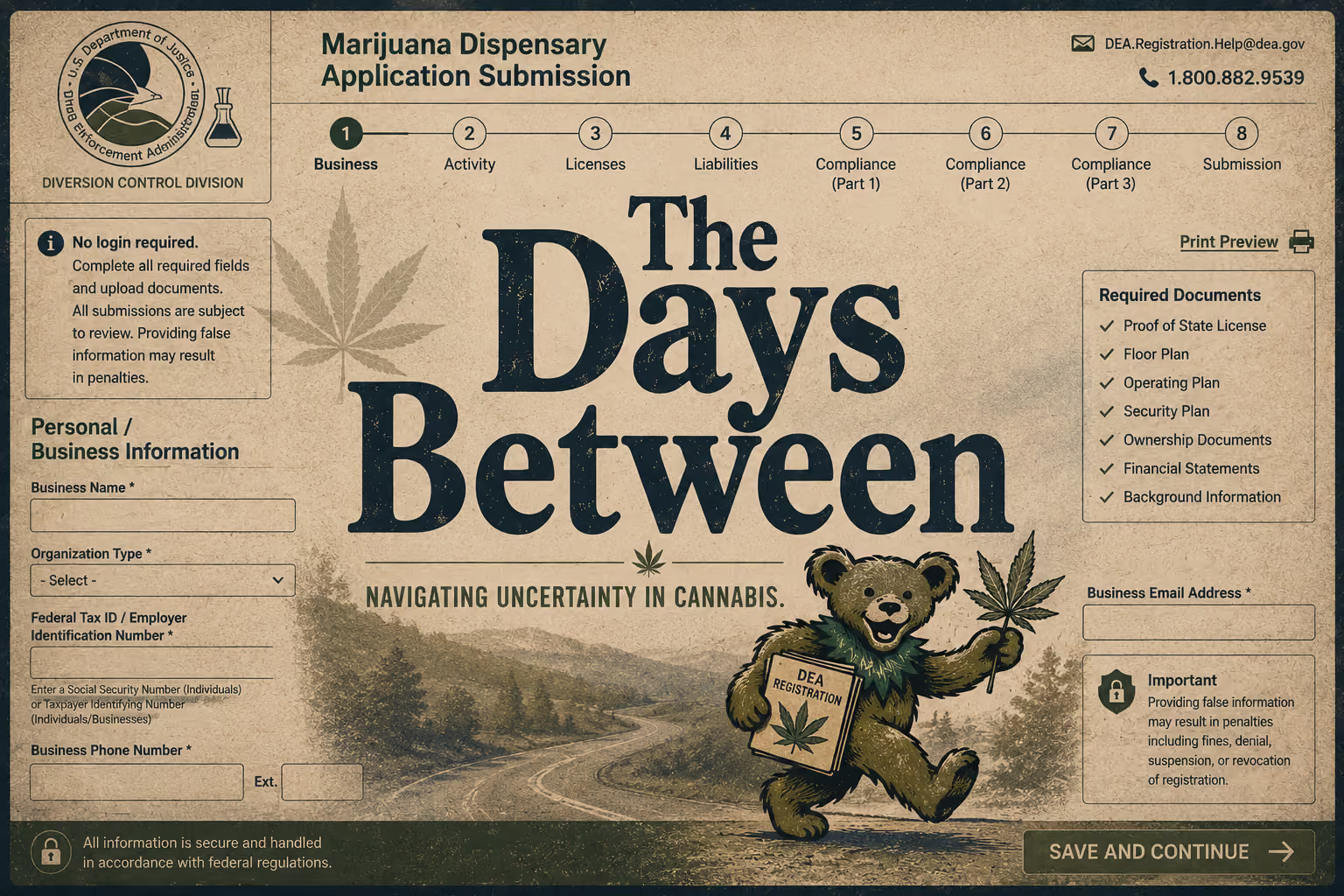
Cannabis operators have learned how to run businesses in uncertainty.
But this moment feels different. For years, much of the industry operated under a strange kind of predictable unpredictability. The rules were difficult. Taxes were punishing. Banking was inconsistent. Federal policy lagged far behind state legalization. But operators at least knew the landscape they were operating in.
Now the landscape itself may be changing.
The federal government has officially moved state-licensed medical marijuana and FDA-approved cannabis products from Schedule I to Schedule III. That is one of the most meaningful federal cannabis developments in decades, especially for medical cannabis operators. Potential 280E relief alone could materially change margins, cash flow, reinvestment capacity, and long-term planning.
But while the announcement was historic, the reality is that many of the actual rules are still being written.
Medical cannabis operators now face a new DEA registration pathway, including detailed compliance requirements, security disclosures, supplier information, inventory controls, recordkeeping expectations, and registration fees. Treasury and the IRS have already indicated additional guidance is coming on the tax consequences of the order, including how 280E may apply to businesses operating both medical and adult-use activities. And all at the same time, multiple other federal agencies are reviewing separate cannabis-related policies that could materially impact operators in different ways.
And then there is the adult-use side of the industry.
Many operators assumed rescheduling would broadly impact cannabis as a whole. Instead, adult-use cannabis remains on a separate review path, creating an entirely new layer of uncertainty. DOJ and DEA have announced a broader rescheduling hearing process for adult-use cannabis, but until that process concludes, adult-use remains Schedule I.
That raises difficult questions.
Can one category of cannabis be treated differently from another when operations often share overlapping infrastructure, personnel, inventory systems, facilities, operational processes, and financial management. How will regulators view operators with both medical and adult-use revenue? Will adult-use eventually follow the same path, or has the timeline now become even longer?
Even some of the smaller details surrounding implementation highlight the disconnect operators continue to deal with every day. For instance, the DEA registration portal reportedly requires payment through PayPal, which is hard to ignore in an industry where many operators historically could not access ordinary payment platforms themselves.
There is irony in that.
If federal agencies had to experience even one small piece of the operational friction cannabis businesses deal with every day, from payments to banking to tax treatment to documentation burden… the policy conversation might look very different.
So here we are.
Between Schedule I and Schedule III.
Between announcement and implementation.
Between medical and adult use (and hemp!)
Between tax relief and tax guidance.
Between optimism and operational reality.
As the song goes, “there were days, and there were days between.” Today, cannabis operators are living in those in-between days. And in many ways, they always have been.
Some operators would argue uncertainty itself is not the real challenge anymore. Instability is. Continually shifting rules, fragmented federal policies, evolving state frameworks, delayed guidance, and half-measures that create just enough change to impact strategy, but not enough clarity to plan around confidently.
Truth is, operating in the “days between” is not a temporary condition for cannabis businesses. It is part of the operating environment itself. The operators who recognize that and build durable businesses capable of adapting to constant change, are usually the ones that last. And those periods can often be the hardest ones to navigate. Because while policy discussions continue in Washington, operators still have to run businesses in the present. Payroll still has to run. Vendors still need to be paid. Taxes still need to be managed. Debt obligations do not pause while agencies debate policy language.
The strongest operators in periods like this are usually not the ones making predictions. They are the ones building durable businesses capable of surviving multiple outcomes.
That means maintaining clean financials.
Separating medical and adult-use activity where possible.
Understanding cash position in real time.
Driving efficiencies and watching costs.
Reviewing tax exposure carefully.
Keeping documentation organized.
Stress-testing business decisions against different regulatory scenarios.
And perhaps most importantly… resisting the temptation to treat policy change as a business plan.
Rescheduling may create significant opportunities. It may improve financial performance for some operators. It may improve lending access over time. It may attract additional institutional interest into the industry.
But uncertainty still carries risk.
Operators should prepare for opportunity without depending on it to solve structural problems inside the business. The fundamentals still matter. Financial discipline matters. Reliable banking relationships matter. Cash flow visibility matters. Operational efficiency matters. Thoughtful growth matters.
The operators who stay organized, intentional, and financially healthy during uncertain periods are usually the ones best positioned when clarity finally arrives.
That is where experienced financial partners can make a difference. Not by pretending uncertainty is gone or overpromising what federal policy may eventually become. But by helping operators create stability while the industry continues moving through change.
Because the days between do not have to be wasted days. They can be preparation days. Planning days.
Cannabis has always rewarded operators who can navigate uncertainty without losing sight of the fundamentals.
This moment is no different.
Disclaimer: This article is provided for informational purposes only and does not constitute legal, tax, regulatory, accounting, or financial advice. Cannabis laws and regulations continue to evolve at the federal, state, and local levels. Operators should consult qualified legal, tax, compliance, and financial professionals regarding their specific business circumstances and obligations.